Subterranean termites present a continuous structural hazard across Baltimore's historic architectural landscape. In dense rowhouse districts such as Federal Hill, Fells Point, and Bolton Hill, unexcavated dirt…
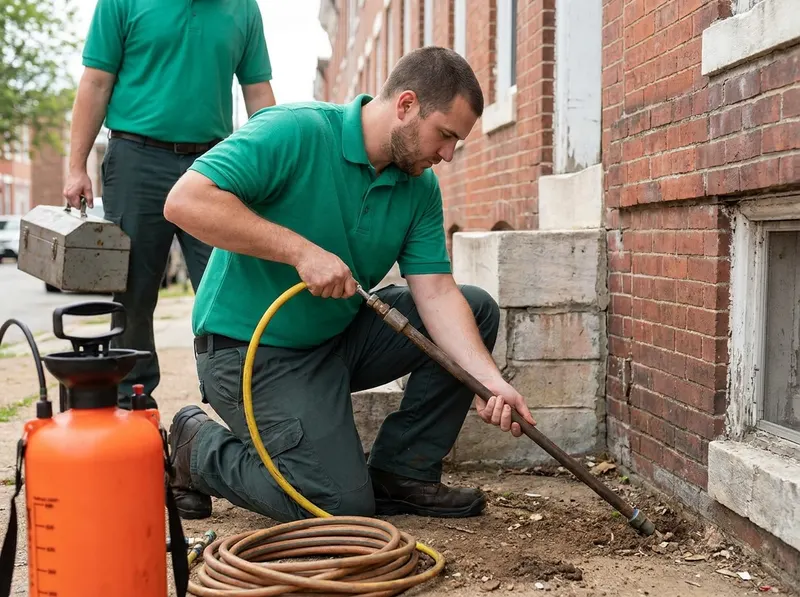
Subterranean termites present a continuous structural hazard across Baltimore's historic architectural landscape. In dense rowhouse districts such as Federal Hill, Fells Point, and Bolton Hill, unexcavated dirt crawlspaces and porous stone foundations provide unmonitored soil-to-wood contact points. Subterranean species establish subterranean central colonies deep beneath the frost line and construct earthen mud shelter tubes over brick and mortar to access structural sill plates and support joists. Over-the-counter surface insecticides fail to protect structural wood because they do not penetrate the soil profile or reach the underground queen, leaving the primary colony intact behind interior plaster walls.
Professional subterranean termite remediation implements non-repellent liquid termiticides alongside targeted bait matrices to halt wood destruction at the biological source. For detached properties in Roland Park and Charles Village featuring wide perimeter soil access, technicians excavate continuous trenches and perform precision sub-slab injections along basement slabs. For interconnected rowhouses in Canton and Patterson Park where exterior soil is limited by concrete sidewalks, tamper-resistant perimeter bait stations intercept foraging workers without invasive masonry demolition. Non-repellent chemical agents adhere firmly to surrounding soil particles, allowing foraging termites to unknowingly transfer the active toxicant throughout the central subterranean colony.
Establishing permanent structural termite defense requires continuous barrier integrity rather than repetitive monthly chemical spraying. Modern soil termiticides and bait systems isolate active treatments below ground level or within locked subterranean housings, keeping living spaces completely protected for household pets and children once applications cure. Technicians analyze site-specific moisture variables—including rubble stone basements near Locust Point and damp ground additions in Hampden—to ensure chemical zones seal all subterranean entry corridors permanently.
Every job gets a firm, written price after a free on-site visit.
Tell us about your subterranean termite remediation job in Baltimore and we'll send a clear, written quote — usually the same day.
 Elvaron Pest Defense